



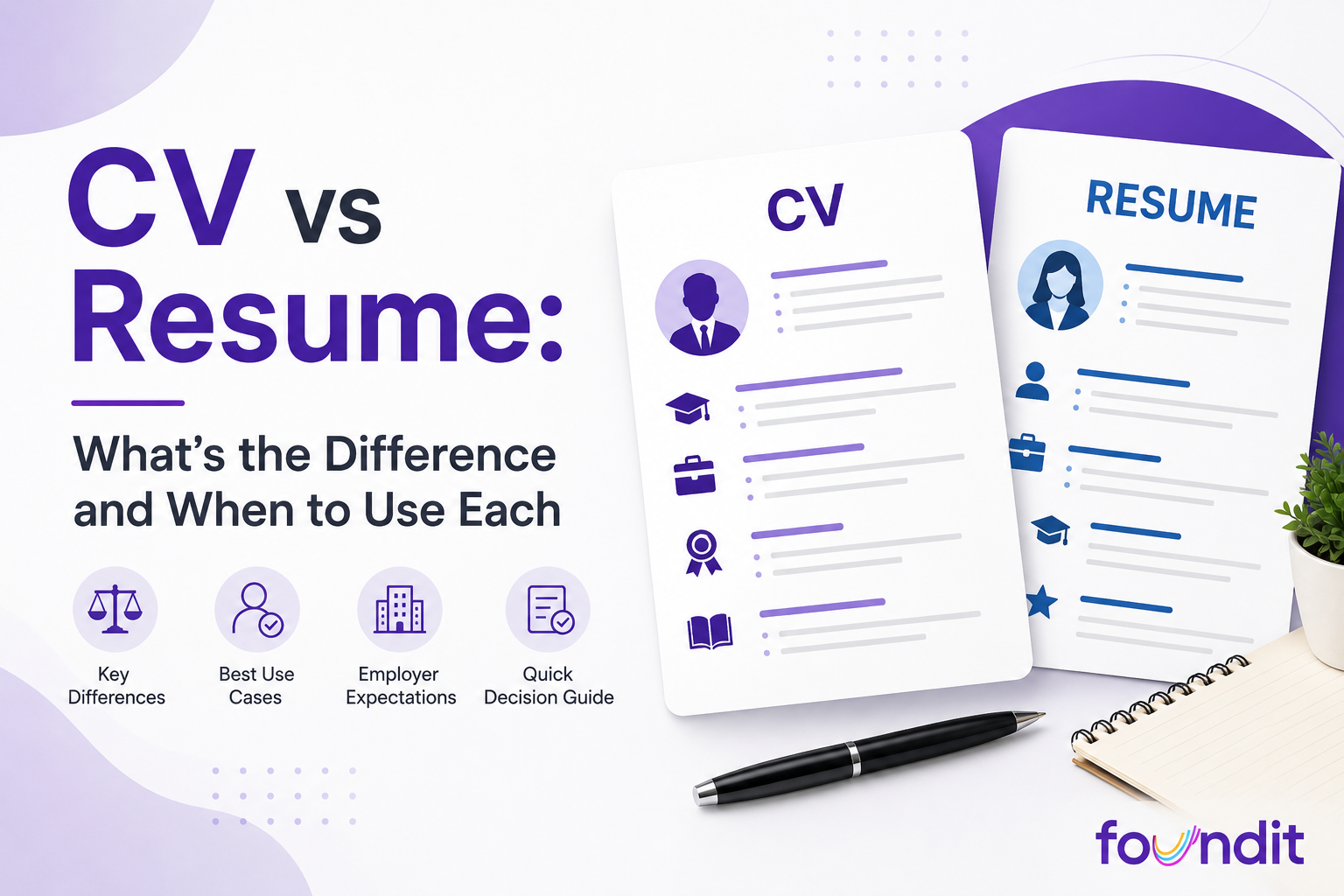
Many job seekers use the terms CV and resume interchangeably, but they are not always the same. While both documents summarise your qualifications and help employers evaluate your suitability for a role, they differ in purpose, length and the type of information they include.
In Malaysia, the distinction can be confusing because employers, recruiters and job portals often use the terms interchangeably for general job applications. However, academic institutions, research organisations and certain specialised professions may expect a traditional curriculum vitae (CV) rather than a resume.
This guide explains the difference between a CV and a resume, when to use each, what employers in Malaysia generally expect and how to choose the right document for your next application.
CV vs Resume at a Glance
| Feature | CV | Resume |
|---|---|---|
| Purpose | Provides a detailed record of academic and professional achievements. | Presents relevant qualifications for a specific job. |
| Length | Flexible and may extend beyond two pages. | Usually one to two pages. |
| Focus | Complete career, research and academic history. | Relevant skills, experience and achievements. |
| Customisation | Updated as new qualifications or achievements are added. | Tailored for each job application. |
| Common Use | Academia, research, teaching and specialised professions. | Corporate, commercial and most private-sector roles. |
Read Also: Top Communication Skills for Resumes
Are a CV and a Resume the Same in Malaysia?
Not always.
From an international recruitment perspective, a CV and a resume have distinct purposes. A CV provides a comprehensive record of your education, research, publications, certifications and professional experience, whereas a resume is a concise document tailored to a specific role.
In Malaysia, however, many employers use the terms CV and resume interchangeably when advertising vacancies. It is common to see job descriptions requesting a "Resume/CV" or simply a "CV", even when the employer expects a concise document suitable for a corporate role.
As a general rule:
- For most private-sector jobs, a well-structured one- or two-page resume is usually sufficient.
- If an employer specifically requests a detailed academic or research profile, prepare a traditional CV.
- When in doubt, review the job description to understand the employer's expectations before submitting your application.
Key Takeaway: For most jobs in Malaysia, employers are looking for a concise document that highlights your relevant qualifications. Unless the role is academic or research-focused, the terms "CV" and "resume" often refer to the same type of job application document.
What is a CV?
A Curriculum Vitae (CV) is a detailed document that presents your academic background, professional experience, qualifications and career achievements. Unlike a resume, which is customised for individual job applications, a CV provides a broader record of your professional journey.
A CV is commonly required for:
- Academic positions.
- Research roles.
- University applications.
- Scholarships and fellowships.
- Teaching appointments.
- Professional positions requiring a comprehensive record of qualifications.
As your career progresses, your CV grows with additional qualifications, publications, certifications, projects, awards and other achievements. Rather than tailoring it extensively for every opportunity, you update it periodically to reflect your latest accomplishments.
Read Also: How to Write a Resume for an Internship
What Does a CV Usually Include?
- Contact information.
- Professional profile or career summary.
- Education and academic qualifications.
- Work experience.
- Research projects.
- Publications.
- Conference presentations.
- Teaching experience.
- Professional certifications.
- Awards and honours.
- Professional memberships.
- Technical and professional skills.
- References, if requested.
What is a Resume?
A resume is a concise document that highlights the qualifications, skills and experience most relevant to a specific job. Instead of presenting your complete career history, it focuses on the information that best demonstrates your suitability for the role.
Most resumes are limited to one or two pages and are customised for every application. Recruiters often spend only a short time reviewing each application, so a resume should be easy to scan and clearly show how your experience aligns with the job requirements.
A resume is commonly used for applications in industries such as:
- Information technology.
- Finance and banking.
- Sales and marketing.
- Human resources.
- Engineering.
- Healthcare.
- Manufacturing.
- Retail and hospitality.
- Most private-sector and multinational organisations.
What Does a Resume Usually Include?
- Contact information.
- Professional summary.
- Relevant work experience.
- Education.
- Technical and soft skills.
- Professional certifications.
- Selected projects or achievements.
- Languages, where relevant.
Read Also: List of Skills to Choose for Resume
CV vs Resume: Key Differences
Although both documents help employers evaluate your qualifications, they serve different purposes. Understanding these differences can help you choose the right document for your next application.
| Factor | CV | Resume |
|---|---|---|
| Primary purpose | Provides a detailed record of academic and professional achievements. | Highlights qualifications relevant to a specific job. |
| Length | Flexible and may extend beyond two pages. | Usually one or two pages. |
| Content | Comprehensive career history, research, publications, teaching and certifications. | Relevant work experience, skills, education and achievements. |
| Customisation | Updated as your career progresses. | Tailored for each application. |
| Best suited for | Academic, research and specialised professional roles. | Corporate and most private-sector positions. |
| Recruiter expectation | Detailed overview of qualifications. | Quick overview of suitability for the role. |
| Review time | Longer due to detailed information. | Designed for quick screening. |
When Should You Use a CV?
A CV is appropriate when an employer or institution requires a comprehensive overview of your academic or professional background. These applications typically place greater emphasis on qualifications, research and long-term career achievements than on concise summaries.
You should generally use a CV for:
- University or academic positions.
- Research and laboratory roles.
- Scholarship and fellowship applications.
- Teaching appointments.
- Medical and healthcare positions requiring detailed credentials.
- Grant applications.
- Professional memberships where detailed qualifications are required.
When Should You Use a Resume?
A resume is the preferred document for most corporate and commercial job applications. It presents the experience and skills that are most relevant to the position without including unnecessary information.
A resume is commonly used for positions in:
- Information technology.
- Banking and financial services.
- Sales and business development.
- Marketing and communications.
- Human resources.
- Engineering.
- Operations and supply chain.
- Customer service.
- Most multinational corporations and private-sector organisations.
What Do Employers in Malaysia Expect?
For most private-sector jobs in Malaysia, employers are primarily interested in a concise document that clearly demonstrates your suitability for the role. Whether the vacancy requests a "CV" or a "resume", recruiters often expect a well-organised document highlighting your relevant experience, skills and achievements.
However, if the position is within academia, research or a specialised profession, employers may expect a traditional CV containing detailed academic and professional information.
| If the Job Is... | Recommended Document |
|---|---|
| Software Engineer | Resume |
| Marketing Executive | Resume |
| Finance Analyst | Resume |
| Research Assistant | CV |
| University Lecturer | CV |
| PhD Scholarship | CV |
CV Example vs Resume Example
Both documents may include similar sections, but the amount of detail differs significantly.
| CV | Resume |
|---|---|
| Contact Information | Contact Information |
| Professional Profile | Professional Summary |
| Education | Relevant Experience |
| Research Experience | Key Skills |
| Teaching Experience | Education |
| Publications | Certifications |
| Conference Presentations | Selected Projects |
| Awards & Honours | Achievements |
| Professional Memberships | Languages (if relevant) |
Common Mistakes to Avoid
- Using a lengthy academic CV for a standard corporate role.
- Submitting the same resume without tailoring it to the job description.
- Assuming every employer requesting a "CV" expects a detailed academic document.
- Including outdated or irrelevant work experience.
- Listing responsibilities without highlighting achievements.
- Adding unnecessary personal information that is not relevant to the application.
- Using inconsistent formatting and difficult-to-read layouts.
- Submitting the document without proofreading.
CV or Resume? A Quick Decision Guide
| Your Situation | Recommended Document |
|---|---|
| Applying for a graduate programme | Resume |
| Applying for a corporate internship | Resume |
| Applying for an executive position | Resume |
| Applying for a research position | CV |
| Applying for a lecturer role | CV |
| Applying for a scholarship or fellowship | CV |
Conclusion
Choosing between a CV and a resume depends on the role you are applying for and the information an employer expects to see. While a CV provides a comprehensive record of your academic and professional achievements, a resume presents the qualifications that are most relevant to a specific job.
For most private-sector opportunities in Malaysia, a tailored resume is usually the preferred choice, even if the job advertisement refers to it as a CV. Before submitting your application, review the job description carefully and prepare the document that best aligns with the employer's expectations.
FAQs
A CV is a detailed document that outlines your academic background, professional experience, qualifications and achievements. A resume is a shorter, tailored document that highlights the skills and experience most relevant to a specific job application.
The right document depends on the role and the employer's requirements. A resume is generally suitable for most corporate and private-sector jobs, while a CV is commonly used for academic, research, teaching and specialised professional positions.
In many organisations, the terms are used interchangeably during recruitment. However, they are technically different documents. Before applying, review the job description to determine whether the employer expects a concise resume or a detailed CV.
A resume is typically one or two pages and focuses on relevant qualifications for a specific role. A CV does not have a fixed length and can extend over multiple pages as it includes a comprehensive record of your education, experience and professional achievements.
Yes. A resume should be tailored for every application by highlighting the skills and experience most relevant to the position. A CV usually requires fewer changes but can still be updated or adjusted to emphasise qualifications that best match the opportunity.
 Beware of Scammers
