






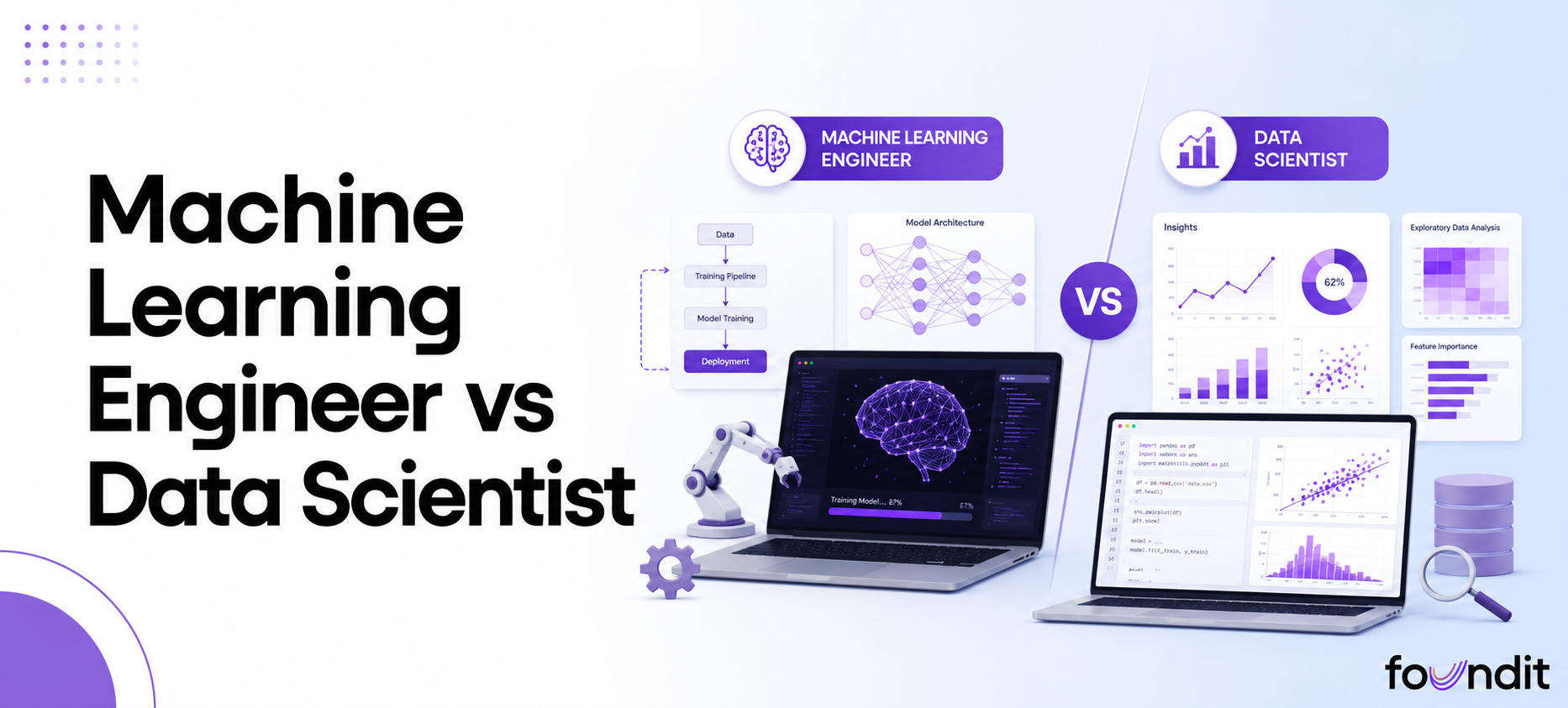
Machine Learning Engineer vs Data Scientist is a popular comparison among those entering the AI field. Although both roles work extensively with data, their responsibilities, required skills, and career outcomes differ significantly.
In Malaysia, where demand for AI and data professionals is growing steadily across various sectors under the MyDIGITAL initiative, understanding the distinction between these two roles is increasingly relevant for Malaysian professionals.
A data scientist works on analysing data and extracting insights, while a machine learning engineer develops and implements AI models.
This guide will break down the difference between a machine learning engineer and a data scientist. It provides information about the roles, skills, pay, education, career milestones, and distinctions between the two professions.
What is a Data Scientist? Role, Responsibilities, and Core Skills
Data Scientist gathers, processes and explains data to support business decisions. The job will be related to real-world problems, involve Python programming, statistical modelling, and business understanding.
The main goal is to find patterns in data and turn those patterns into actionable recommendations. Data scientists work with diverse teams to improve products, customer experiences, and business performance.
Key Responsibilities of a Data Scientist
Here are some of the main data scientist roles and responsibilities:
- Obtain, clean and assemble information from multiple sources.
- Perform exploratory data analysis (EDA) to look for trends and patterns.
- Create predictive modelling solutions with machine learning and statistical methods.
- Build reports and data visualisation dashboards for business teams.
- Conduct experiments and test different business ideas using data.
- Collaborate with stakeholders to grasp business issues and build solutions based on data.
Skills Required for a Data Scientist in 2026
Following are the skill required for a data scientist:
- Programming Skills: Gain proficiency in programming languages such as Python, Structured Query Language (SQL), and R to clean, analyse, and manipulate large datasets efficiently.
- Statistical Knowledge: Develop a strong understanding of statistics, probability, hypothesis testing, and predictive modelling to interpret data accurately and make evidence-based decisions.
- Data Analysis Libraries: Learn to work with popular Python libraries such as Pandas, NumPy, SciPy, and scikit-learn for data preparation, analysis, and machine learning model development.
- Feature Engineering: Understand how to select, transform, and create meaningful features that improve the accuracy and performance of machine learning models.
- Data Visualisation: Build clear and interactive dashboards using tools such as Tableau, Microsoft Power BI, or libraries like Matplotlib to communicate insights effectively.
- Machine Learning and Deep Learning: Understand core machine learning algorithms, supervised and unsupervised learning techniques, and the fundamentals of deep learning to solve complex business problems.
- Communication Skills: Develop strong written and verbal communication skills to explain technical findings, present actionable insights, and collaborate effectively with both technical and non-technical stakeholders.
- Business Acumen: Understand business objectives and industry-specific challenges to translate data insights into practical recommendations that support strategic decision-making.
- Problem-Solving Skills: Apply critical thinking and analytical reasoning to identify patterns, troubleshoot issues, and develop data-driven solutions for real-world business challenges.
- Data Storytelling: Learn to present complex data in a simple, engaging manner that helps decision-makers understand trends, risks, and opportunities without requiring technical expertise.
Read Also: Data Scientist Job Description [2026]
What Does a Machine Learning Engineer Do? From Model Building to Production
A machine learning engineer builds, evaluates and implements machine learning models into the real world. Unlike a data scientist, the focus is on building reliable systems that can handle large volumes of data and users.
Machine learning engineers are tasked with developing ML systems in production and ensuring they maintain high accuracy once they are used. They also work with software developers and data engineers to create scalable AI solutions.
Core Responsibilities of a Machine Learning Engineer
The following are the core responsibilities of a machine learning engineer:
- Create, implement and publish machine learning models.
- Control the deployment of the model to production settings.
- Use feature engineering and testing to improve model performance.
- Construct and maintain production of ML systems for real time applications.
- Keep an eye on model accuracy and retrain the models if needed.
- Learn how to automate deployment and maintenance with MLOps practices.
- Work with developers and cloud teams on developing scalable AI applications.
Skills Required for a Machine Learning Engineer
The following are the machine learning engineer skills required:
- Python Programming: Develop strong proficiency in Python to build, test, and optimise machine learning models using industry-standard frameworks and libraries.
- Machine Learning Frameworks: Gain hands-on experience with popular frameworks such as TensorFlow, PyTorch, and scikit-learn for developing, training, and evaluating machine learning models.
- MLOps and Model Deployment: Understand Machine Learning Operations (MLOps) principles, including model deployment, monitoring, versioning, and lifecycle management in production environments.
- Machine Learning and Deep Learning: Build a solid foundation in supervised and unsupervised learning, neural networks, and deep learning techniques to solve complex business problems.
- Cloud Computing: Learn to deploy and manage AI applications using cloud platforms such as Amazon Web Services (AWS) and Microsoft Azure, while understanding cloud-based machine learning services.
- Programming and Version Control: Strengthen programming, debugging, testing, and version control skills using tools such as Git to support collaborative software development.
- Production System Optimisation: Develop the ability to optimise machine learning pipelines, improve model performance, troubleshoot deployment issues, and maintain reliable production systems.
- Data Engineering Fundamentals: Understand data preprocessing, feature engineering, and data pipeline development to ensure machine learning models receive high-quality input data.
- Software Engineering Practices: Follow coding standards, write maintainable code, and implement automated testing and continuous integration to build robust machine learning applications.
- Problem-Solving and Collaboration: Combine analytical thinking with effective communication to work closely with data scientists, software engineers, and business stakeholders on AI-driven projects.
Read Also: Analytical Skills: Meaning, Examples, Resume Tips & How to Improve
ML Engineer vs Data Scientist: Head-to-Head Comparison
Although both roles work with data and artificial intelligence, their day-to-day responsibilities are quite different.
The following table lists the top highlights of machine learning vs data science, ranging from skills to work, tools, and career progression.
| Comparison | Data Scientist | Machine Learning Engineer |
| Primary focus | Gathers and processes data to identify trends and make business recommendations. | Develops, evaluates, and implements machine learning models in practical scenarios. |
| Daily responsibilities | Prepares exploratory data analysis (EDA), builds predictive models, and prepares reports and dashboards. | Develops machine learning pipelines, implements models, and monitors model performance |
| Main objective | Supplies information and statistical modelling to assist organisations with informed business decisions. | Maintains machine learning models in a reliable and efficient manner in a production ML system. |
| Common tools | Utilises Python, SQL, scikit-learn, Tableau, Power BI, and other tools for data analysis. | Uses Python, TensorFlow PyTorch, Docker, Kubernetes, and cloud platforms. |
| Key skills | Excellent statistical, data visualisation, communication, and business analysis skills. | Familiarity with software development, MLOps, cloud technologies and machine learning frameworks. |
| Team collaboration | Often collaborates with business teams, analysts, and stakeholders to find solutions to business problems. | Works primarily with software developers, data engineers, and DevOps teams to create AI solutions. |
| Typical output | Provides reports, dashboards, predictive models, and actionable business insights. | Supports large-scale AI deployment and automation usage, as well as machine learning models. |
| Career progression | May progress to Assistant Data Scientist, Senior Data Scientist, Lead Data Scientist or Head of Data Science. | Can progress to Senior Machine Learning Engineer, ML Architect, AI Engineering Manager, or Engineering Leader. |
Both professions are technical but with different objectives.
The role of a data scientist is more to analyse data to solve business problems, whereas a machine learning engineer is more about developing, deploying, and maintaining an AI model that can be trusted in production.
Read Also: Top 10 Highest Paying Tech Skills to Learn in 2026 [With Learning Paths]
Salary Comparison: ML Engineer vs Data Scientist in Malaysia- H2
When comparing machine learning engineer vs data scientist salary comparison, machine learning engineers earn higher salaries. This is because machine learning, software development and productionising AI models are expertise needed for the position.
The table below lists the data scientist vs machine learning engineer salary at various experience levels in Malaysia.
| Experience Level | Data Scientist Salary (RM p.a.) | Machine Learning Engineer Salary (RM p.a.) |
| Entry-level (0–2 years) | RM 44,998 – RM 58,084 | RM 48,543 – RM 49,156 |
| Mid-level (3–5 years) | RM 56,971 – RM 80,731 | RM 49,156 – RM 94,286 |
| Senior (6–10 years) | RM 80,731 – RM 122,890 | RM 94,286 – RM 145,000 |
| Lead (10+ years) | RM 122,890+ | RM 145,000+ |
Disclaimer: Salary levels are indicative and may vary based on the employer, industry, job role, experience, skills, qualifications, location, and prevailing market conditions. Verify the latest salary information through official company career pages or trusted salary platforms before making career decisions.
Read Also: 15 Best Technical Skills for Your Resume in 2026 with Examples
Which Cities Pay the Highest Salaries?
The location, industry, and demand for AI professionals also play a role in determining salary levels. Below are the average mid-level salary ranges of the leading technology hubs in Malaysia.
Data Scientist salary by city / hub
Machine Learning Engineer salary by city / hub
| City / hub | Machine learning engineer salary (RM p.a.) |
| Kuala Lumpur | RM 144,000 – RM 240,000 |
| Penang | RM 96,000 – RM 176,000 |
| Cyberjaya | RM 108,000 – RM 192,000 |
| Johor Bahru | RM 90,000 – RM 160,000 |
| Other major hubs | Varies by company, industry, and experience |
Kuala Lumpur usually leads because it has the largest concentration of finance, technology, and enterprise employers, which increases competition for skilled AI talent.
Penang and Cyberjaya also pay well because of their strong tech ecosystems, with Penang supported by manufacturing and semiconductor demand, and Cyberjaya supported by multinational and digital-focused employers.
Read Also: High Paying Work from Home Jobs for 2026
Education and Career Path: How to Become an ML Engineer or Data Scientist
The machine learning engineer vs data scientist education requirements are different, although both careers require a strong understanding of programming and data. The learning path will vary depending on the individual’s interests and career objectives.
Typically, a data scientist will begin with a bachelor’s degree in Statistics, Mathematics, Computer Science, Economics, or another related field. Courses leading to a machine learning, data analytics and statistical modelling certification may enhance career prospects.
The typical machine learning engineer will have a solid background in Computer Science/Software Engineering. Some knowledge in algorithms, software development, python programming, and cloud platforms is useful for building and deploying machine learning applications.
Others also pursue certifications in MLOps, cloud technologies, and machine learning to enhance their expertise. Recognised courses are available on platforms like Coursera, edX and AWS to acquire hands-on knowledge.
In Malaysia, professionals can also explore HRD Corp claimable programmes in data science, machine learning, and AI engineering, where registered employers can fund training costs for eligible employees.
MDEC-endorsed courses and globally recognised certifications from Google, AWS, and Microsoft are widely valued by Malaysian employers across technology, shared services, and financial services sectors.
Today, employers are more interested in hands-on experience than in formal education. Roles in AI careers can be enhanced by building projects, contributing to open-source initiatives, and building a robust portfolio.
Can You Switch Between Data Science and ML Engineering?
Yes, it is possible to transition between the two professions, but it requires the right skills and experience. Indeed, among AI professionals, one of the most frequently asked career questions is can a data scientist become a machine learning engineer?
To transition from a data scientist to machine learning engineering, it may be necessary to enhance software engineering abilities and to gain experience in the deployment of machine learning models. The following steps can help make the transition easier:
Understand the concepts of software engineering: Git, Testing, API, Version Control.
Develop hands-on experience with MLOps, Docker, Kubernetes, and cloud platforms.
Learn by doing the deployment of models by creating end-to-end machine learning projects.
Seek out career paths in AI or machine learning-related jobs to build hands-on experience in the industry before entering a full-time role as an ML engineer.
Likewise, a machine learning engineer can move into data science by improving their understanding of statistical modelling, exploratory data analysis (EDA), and data visualisation.
Understanding how to communicate and share business insights from data will also be crucial to data science careers.
Ongoing education and hands-on project experience are key components in long-term success in an AI career, no matter the path.
Which Career Fits You Better: Machine Learning Engineer or Data Scientist?
There is not a single “better” choice between these two roles. The right path depends on what kind of work you naturally enjoy, your strengths, and how you prefer to solve problems.
Consider Data Science if:
- You are comfortable working with statistics, patterns, and data interpretation
- You enjoy explaining insights clearly to people who may not have a technical background
- You are more interested in understanding trends, causes, and “why something is happening”
- Your background is closer to mathematics, economics, analytics, or research-oriented work.
In short, data science is more about analysing information and turning it into meaningful business insights.
Consider Machine Learning Engineering if:
- You prefer writing production-level, structured, and maintainable code
- You like thinking about how systems work together in real-world environments
- You are more interested in building and deploying models than just experimenting with them
- You come from a computer science or software engineering background
In simple terms, ML engineering focuses more on building scalable systems that run reliably in production.
Read Also: Career Planning Process: Complete Step-by-Step Guide
Conclusion
Both machine learning engineering vs data science play distinct but complementary roles in building AI-powered solutions, and both are establishing themselves as high-value career paths within Malaysia’s rapidly expanding digital economy.
Data scientists bring analytical depth and statistical expertise that helps organisations understand their data and make better decisions. Machine learning engineers bring the engineering discipline needed to turn those insights systems that operate reliably at scale.
For professionals in Malaysia, where shared services, financial technology, and manufacturing are all undergoing active AI-driven transformation, both paths offer strong long-term career prospects and competitive compensation.
The right choice depends on whether you are drawn more to analysis and insight generation or to building and deploying systems at scale. Either way, Malaysia’s AI job market is growing in both directions and rewards strong expertise in both specialisations.
FAQs
A data scientist is somebody who works with data to look for patterns and provide insights for business. A machine learning engineer is responsible for putting those models into production systems which can be scaled up.
Machine learning engineers in Malaysia typically earn more than data scientists at comparable experience levels. This reflects the combined demand for skills that ML engineering roles require, particularly within Malaysia's emerging sectors.
Yes, this is a very typical transition. Strengthening your software engineering, Machine Learning Operations (MLOps), and model deployment skills can help you make the switch successfully.
Top skills include knowledge of python programming, machine learning frameworks (TensorFlow, Pytorch), cloud platforms (AWS, Azure), MLOps, testing, and system design.
Absolutely machine learning is a part of data science. Data science has a wider range of concepts that includes statistics, data analysis, visualisation and business intelligence, and machine learning is more focused on creating predictive models and systems.
Both roles are in growing demand in Malaysia. Machine learning engineering demand is rising faster given the increasing adoption of production-grade AI systems across various sectors undergoing Industry 4.0 transformation. Data science roles are also expanding steadily across organisations that rely on data-driven decision-making, including banking, e-commerce, and healthcare companies operating across Malaysia and the broader Southeast Asian region.
 Beware of Scammers
